



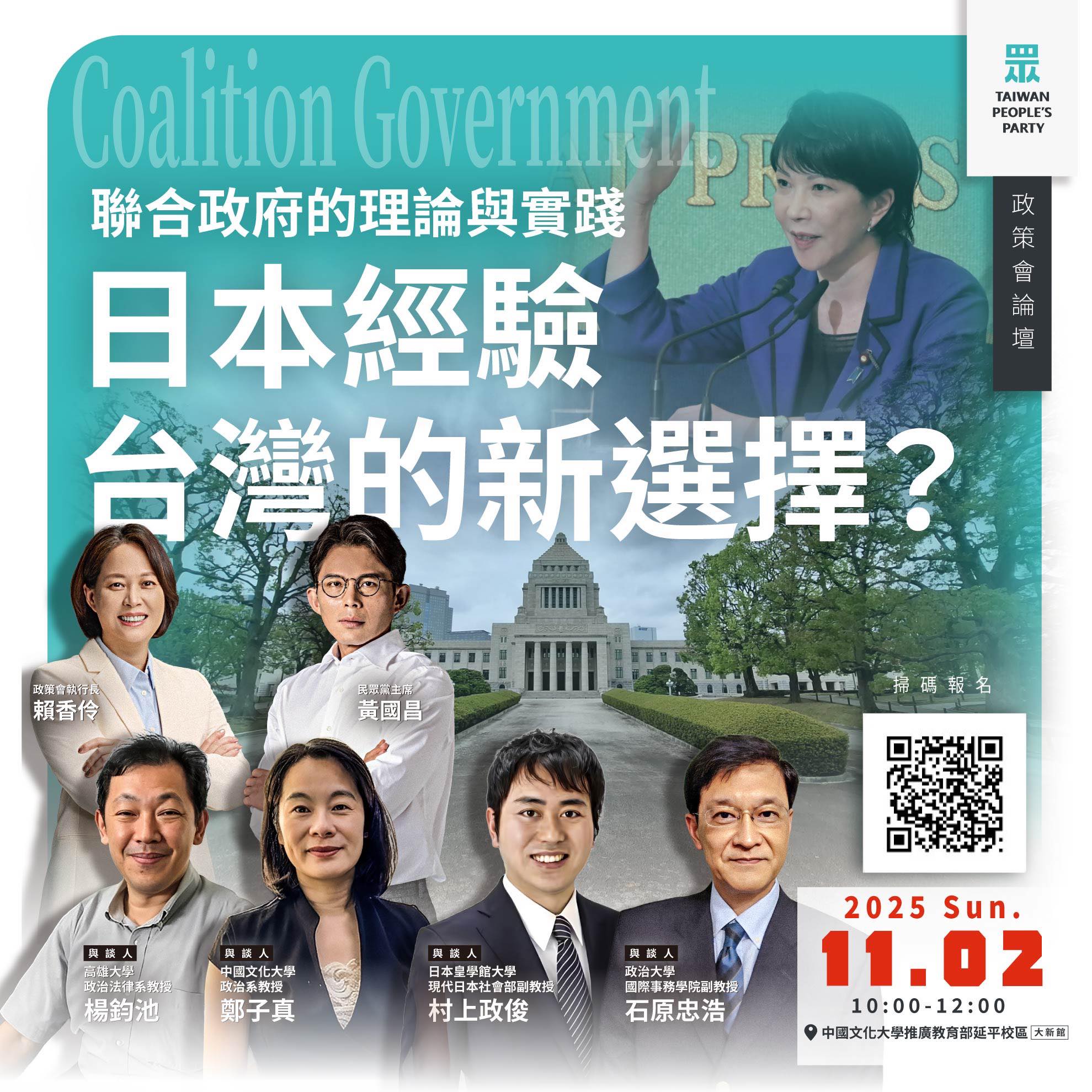
“Theory and Practice of Coalition Government — Japan's Experience, A New Choice for Taiwan” Forum
“Theory and Practice of Coalition Government — Japan's Experience, A New Choice for Taiwan” Forum
2025/11/2 @ School of Continuing Education, Chinese Culture University.
Parties with differing positions and ideologies putting aside disagreements to reach consensus and advance legislation on social welfare, people’s livelihoods, and economic policy — in service of what citizens truly need — is a hallmark of a mature democracy and the primary purpose of a coalition government.
The TPP's Policy and Strategy Department today hosted the forum “Theory and Practice of Coalition Government — Japan’s Experience, A New Choice for Taiwan.” Domestic scholars invited included Professor Yang Junchi of the Department of Political Science and Law at National Kaohsiung University and Professor Cheng Tzu-chen of the Department of Political Science at Chinese Culture University. Japanese experts included Masatoshi Murakami, former member of the House of Representatives for the Japan Innovation Party, and Associate Professor Tadahiro Ishihara of the College of International Affairs at National Chengchi University. Speakers shared the historical development, practical operation, and forthcoming challenges of Japan’s coalition government system.
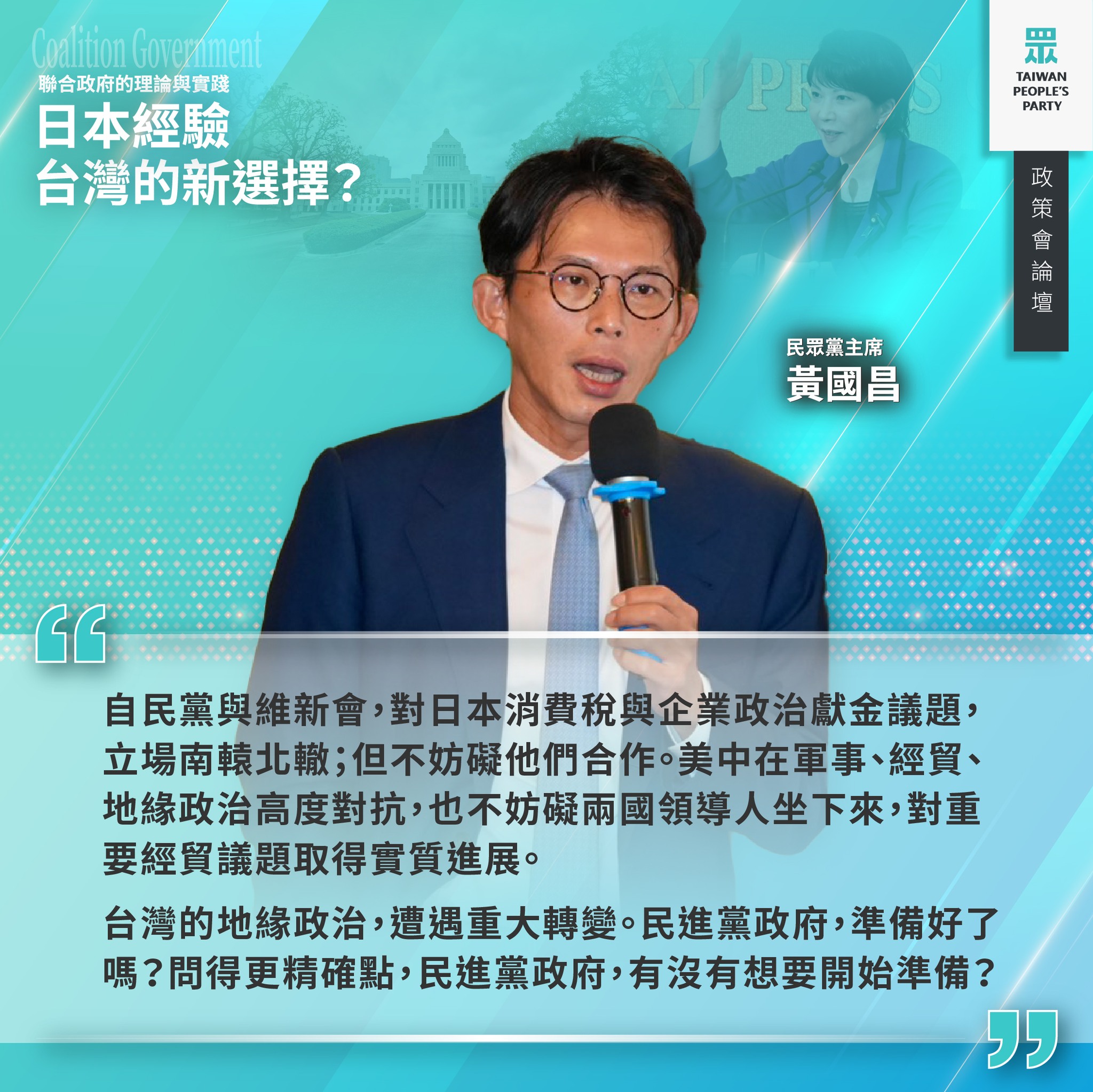
TPP Chairman KC Huang commented that the Liberal Democratic Party (LDP) and the Japan Innovation Party (Ishin) have signed coalition governance agreements that have produced consensus across defense, diplomacy, domestic affairs, finance, energy, and even healthcare and eldercare. Looking internationally, despite military, trade, and geopolitical competition between the U.S. and China, leaders of both powers are still able to sit down and negotiate, making substantive progress on economic and trade issues. Faced with major shifts in the international environment, is the DPP government prepared? Have they started preparing?
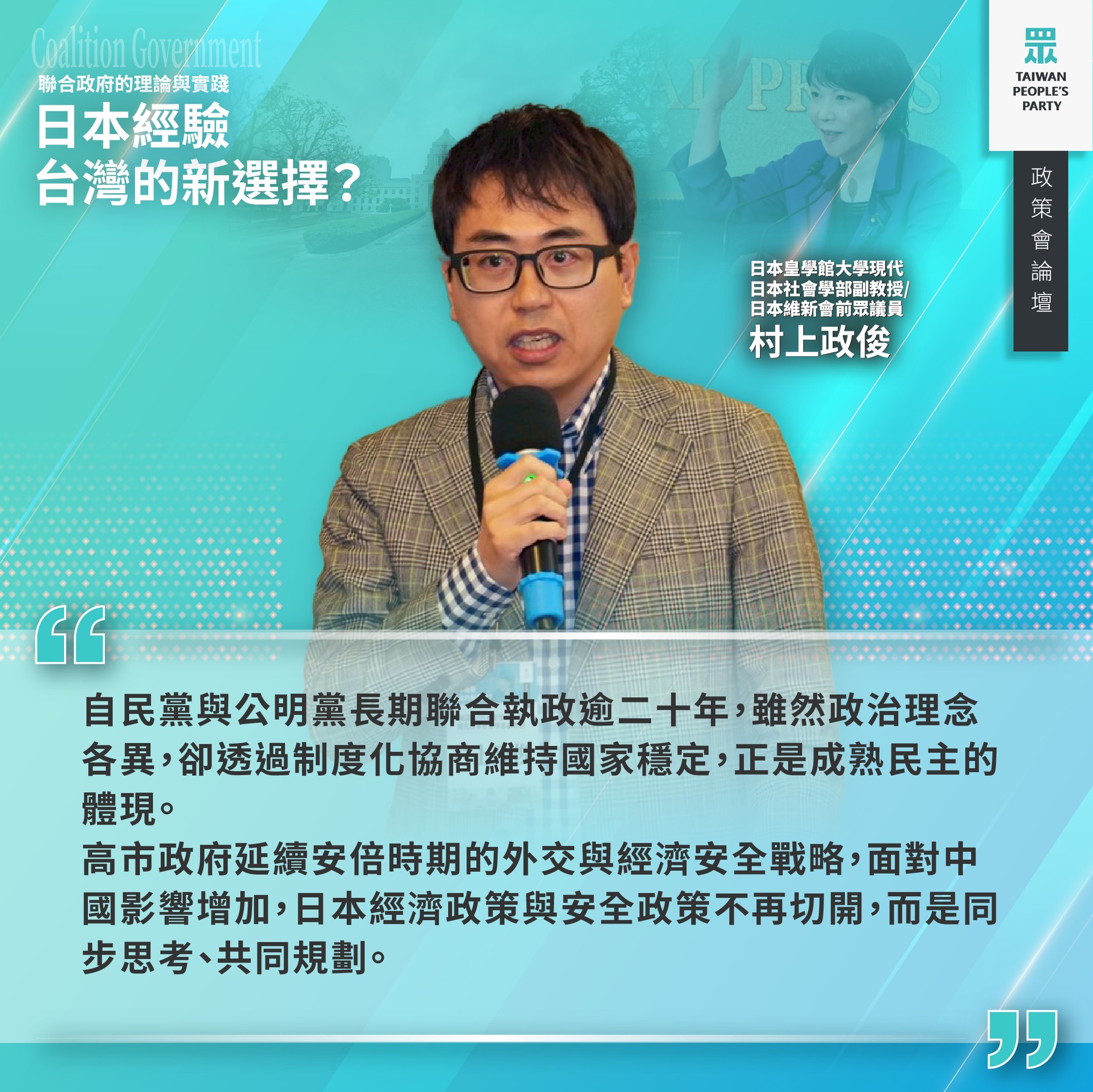
Masatoshi Murakami, former member of the House of Representatives for the Ishin and also Associate Professor in the Department of Modern Japanese Sociology at Kokugakuin University, flew to Taiwan last night specifically for this forum and returned to Japan immediately after the event, underscoring the importance he places on coalition government issues. Professor Murakami argued that under Japan’s bicameral system, the governing party must engage in cross-party cooperation to ensure political stability. Although the LDP and Komeito differ ideologically, they maintain national stability through institutionalized consultation; their long-running coalition government for more than twenty years “is precisely an expression of a mature democracy.”
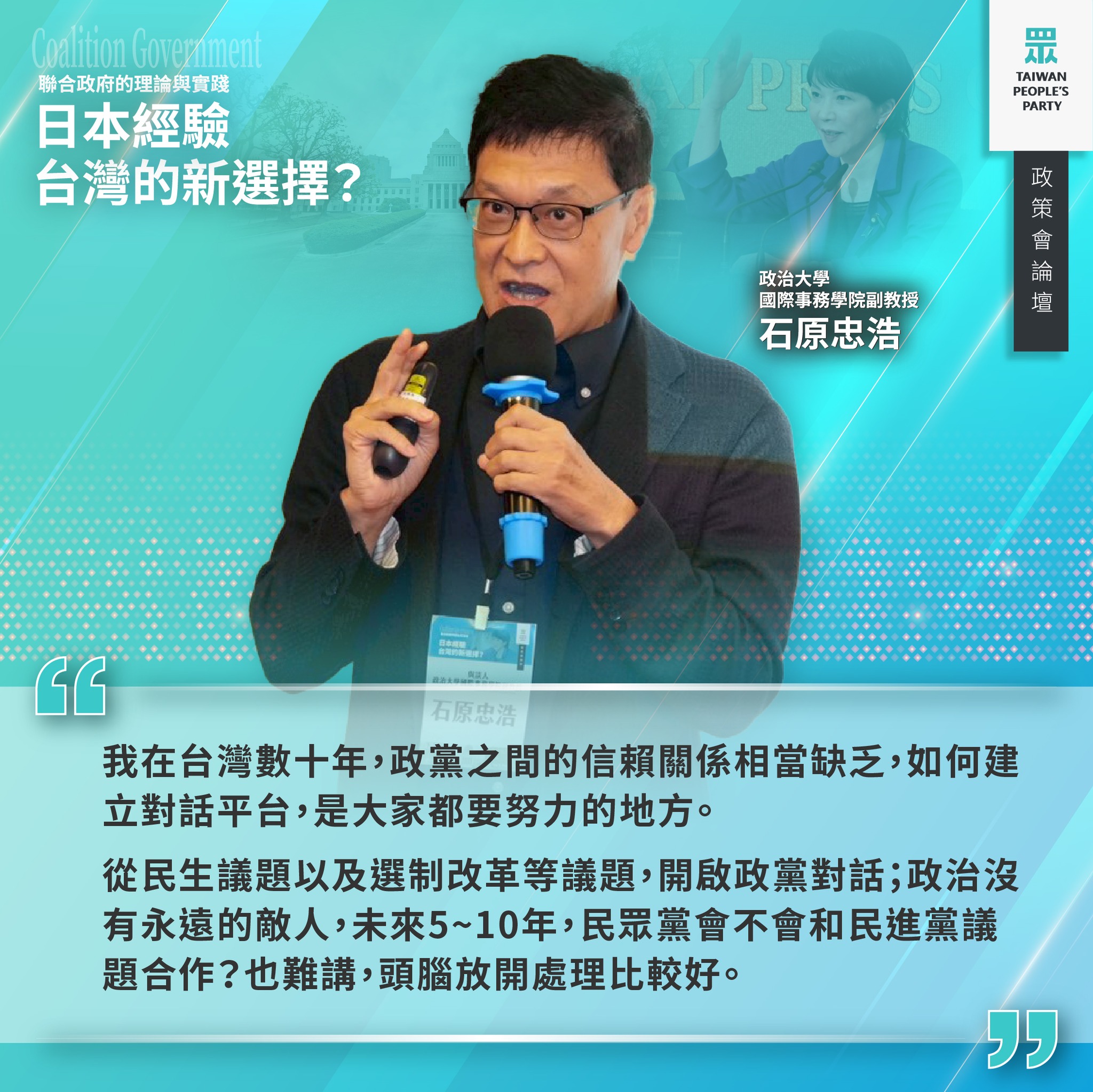
Associate Professor Tadahiro Ishihara of NCCU's College of International Affairs noted that Japanese politics is moving into a new era of institutionalized multi-party cooperation. Multi-party politics is the trend: parties have parliamentary strategy committees or policy research councils that jointly discuss policy differences. By making political differences understandable to the public — rather than relying on behind-closed-doors deals — parties can reach consensus through institutionalized dialogue. This model offers lessons Taiwan can learn from.

Professor Yang Junchi of the Department of Political Science and Law at National Kaohsiung University reminded the audience that Japan's coalition practice began only after the LDP lost its majority in the House of Councillors in 1998 and formed a partnership with Komeito to stabilize legislative procedures through a “numerical union,” and later gradually developed policy alignment. He cautioned that while coalition government seeks political stability and institutional resilience, it must also honestly confront the real challenges of inter-party competition.
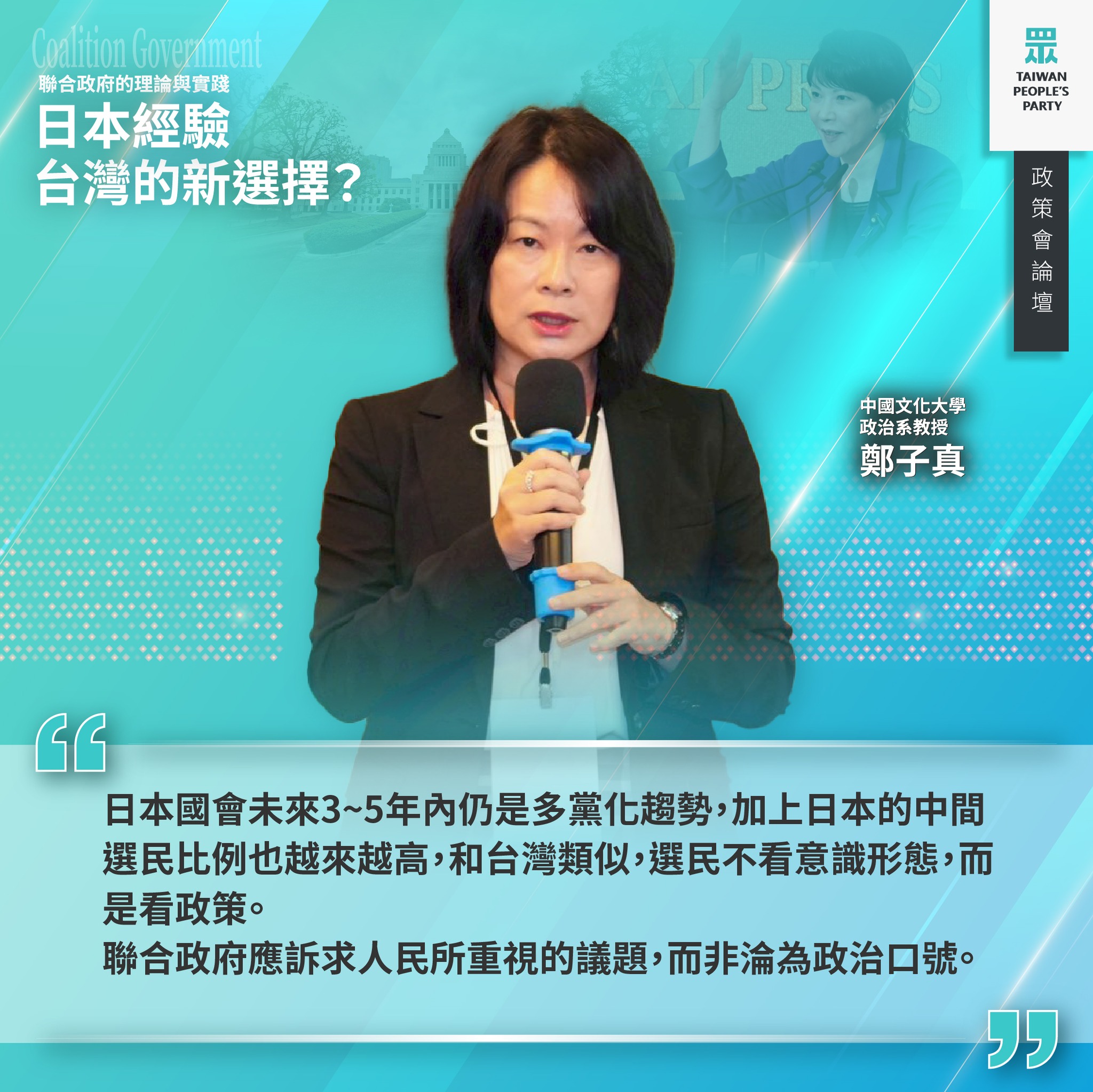
Professor Cheng Tzu-chen of Chinese Culture University's Department of Political Science pointed out that Japan has entered a stage of multi-party politics in which over 40% of voters identify as swing voters who “vote on policy rather than party color.” Taiwan should learn from Japan's experience: whether through coalition government or intra-party factional negotiations, policy integration and institutionalized dialogue — not mere rhetoric and conflict — should be the path forward.
Over the past year, the Taiwan People's Party has concretely fulfilled promises to voters by cooperating with the Kuomintang in the legislature to jointly advance multiple bills — including parliamentary reform, the Act Governing the Allocation of Government Revenues and Expenditures, the Whistleblower Protection Act, and legislation to restore earned leave to citizens — demonstrating policy-driven collaboration based on shared public interest.
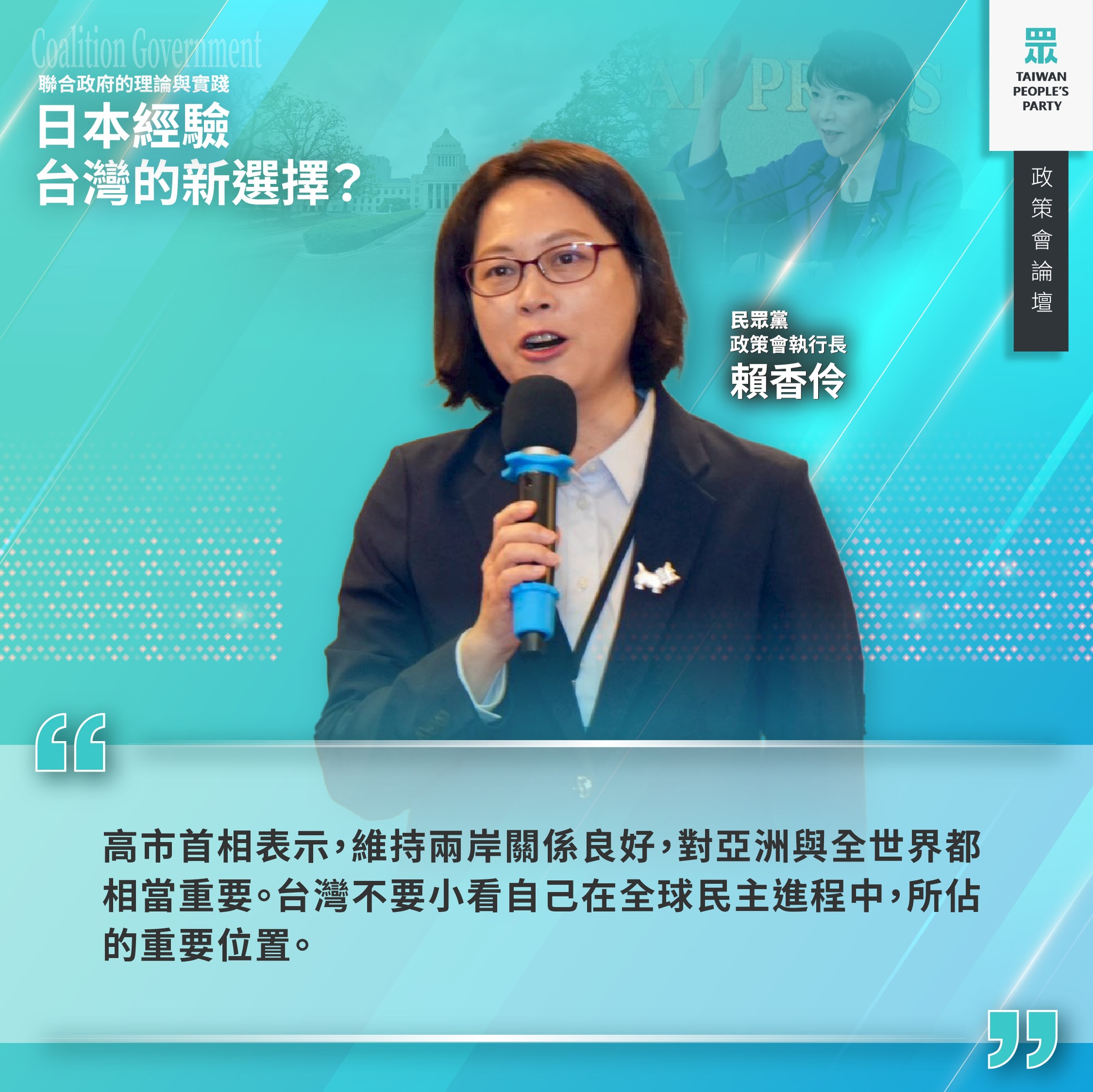
Regrettably, when the Taiwan People's Party works for the nation's long-term stability and pursues constitutional reform, the DPP often responds with outdated political reflexes, attacking rather than engaging on the merits and reflexively smearing the topic of “coalition government.” This not only reveals a fear of pluralistic democratic progress, it also exemplifies how “those who do harm often cannot understand why others choose to do good.”
We earnestly suggest that DPP Chair Lai Ching-te and the party's public affairs apparatus prioritize the nation's long-term stability, absorb new ideas, and change their mindset. Holding power should not mean suppressing all dissenting voices and betraying the “Democratic Progressive” name.