



TPP Caucus Response to President Lai Ching-te's November 26 Press Conference
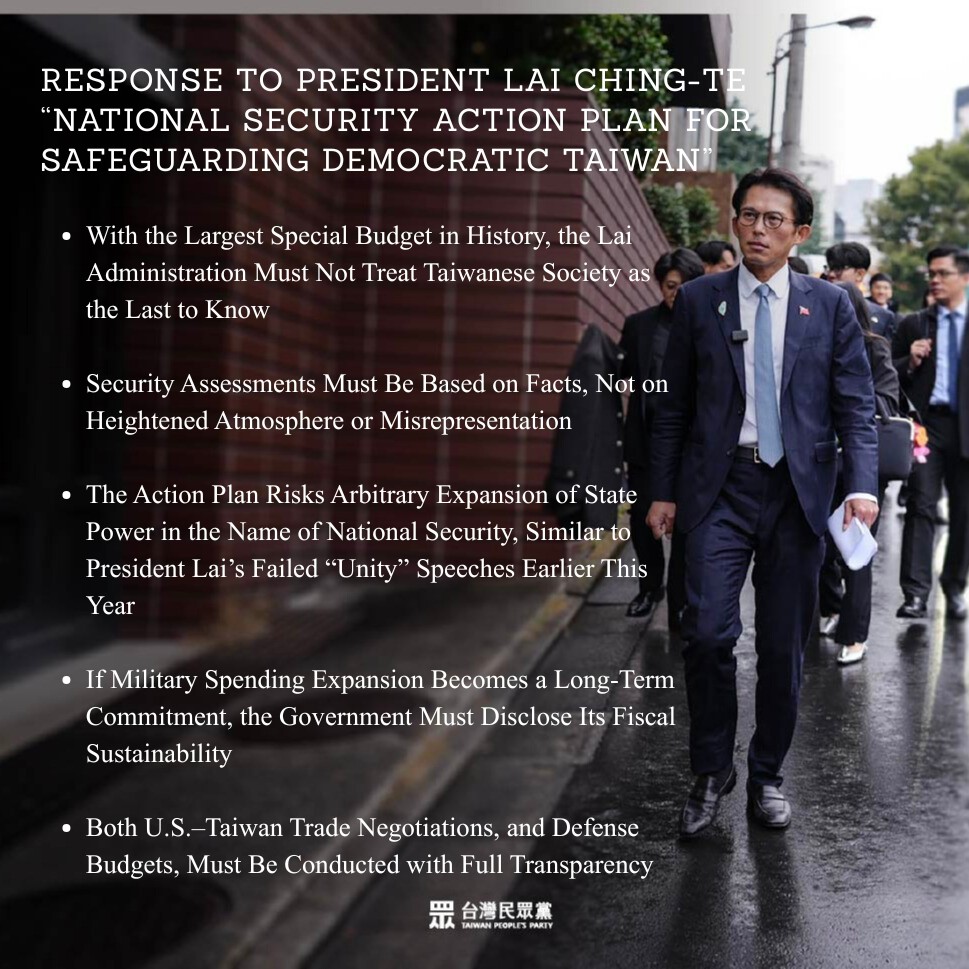
In response to President Lai Ching-te’s press conference on November 26, the Taiwan People’s Party caucus issues the following statement:
I. The Taiwan People’s Party Caucus Supports a Reasonable Increase in the National Defense Budget and Will Conduct Rigorous and Pragmatic Review
President Lai has pledged to build a “T-Dome’ Missile Shield” by establishing a comprehensive air defense network and integrating artificial intelligence to develop rapid-response battlefield decision-making systems. This vision is certainly commendable and aligns with the direction and objectives that Taiwan’s armed forces should pursue in response to high-tech warfare trends. Only through upgrading equipment and strengthening integration, management, and operational application—under a comprehensive defensive and combat-ready strategic framework—can Taiwan build a truly modernized military capable of effective combat, thereby substantially enhancing overall defense strength and capabilities.
The Taiwan People’s Party supports a reasonable increase in the national defense budget and the genuine strengthening of Taiwan’s self-reliant defense capabilities. However, in several past special military budget programs, there have been repeated instances where funds were appropriated but equipment deliveries were significantly delayed, resulting in outcomes that fell far short of public expectations and the original purpose of such special budgets.
Once the Executive Yuan submits the special budget to the Legislative Yuan, the TPP legislative caucus will incorporate into its evaluation a full range of considerations, including military infrastructure development, overall operational needs, and personnel requirements. The caucus will conduct a strict yet pragmatic review of the proposed budget.
II. Peace Is Sustained by Strength—National Defense Policy and Budgeting Should Not Be Built on Intimidating the Public or Amplifying Social Fear
President Lai has asserted that Beijing is “aiming to forcibly unify Taiwan by 2027.” This narrative, however, shows a clear discrepancy with the contents of publicly available U.S. assessments. U.S. President Donald Trump has already stated openly that he does not believe the Chinese Communist Party will launch an attack on Taiwan in 2027. Moreover, the latest report released by the U.S. Congress on the 18th of this month also indicates that “2027” does not constitute a specific timetable for military action.
As head of state, President Lai bears the responsibility to clearly explain to the public—on the basis of credible intelligence and professional analysis—how the government arrived at its assessment of a so-called “2027 threat.” He should not, in the absence of concrete evidence, employ sensationalized rhetoric that intensifies public anxiety over war and thereby distorts the foundation for sound policy judgment. National security must not become a tool for political mobilization. It must return to the realm of professionalism and rationality, so as to avoid pushing Taiwan into a needless cycle of fear and confrontation.
III. The Action Plan Risks Arbitrary Expansion of State Power in the Name of National Security, Similar to President Lai’s Failed “Unity” Speeches Earlier This Year
President Lai Ching-te’s “Action Plan” specifically highlights the need to counter gray-zone interference and cognitive warfare from mainland China, and states that the government will strengthen the “legislative process” to establish that the “One Country, Two Systems Taiwan Model” is an untouchable red line for Taiwanese society. On this basis, the administration intends to set institutional regulations governing political dialogue and exchanges with China by domestic political parties, legal entities, and civic groups. Yet the Lai administration must clearly define where the boundaries lie between citizens’ and organizations’ freedom of expression and these so-called red lines.
The President’s remarks inevitably evoke memories of the Democratic Progressive Party’s previous attempts to launch Great Recall campaigns, during which opposition figures were deliberately labeled as “local collaborators of the CCP,” and the opposition’s constitutionally mandated budget-review authority was distorted and attacked as an act of national division. President Lai’s comments today resemble the “purging of impurities” rhetoric found in the historical “Ten Talks on Unity,” causing public anxiety and concern.
Many fear that Lai Ching-te’s “Action Plan” may legitimize the arbitrary expansion of state power and open the door to governmental harassment or infringement on citizens’ freedoms and security. It could even intensify social distrust and instability.
IV. Frequent Creation of Task Forces and Committees: Lai Ching-te Claims to “Protect Democracy” While Hollowing It Out in Practice
President Lai stated that he will coordinate with relevant ministries to establish a “standing task force” that will promote the narrative of “democratic Taiwan versus authoritarian China” to demonstrate Taiwan’s determination to safeguard democracy. The Taiwan People’s Party caucus in the Legislative Yuan questions whether such a task force will merely create another redundant layer on top of the existing diplomatic and national security apparatus. The so-called goal of “showcasing our determination to defend democratic Taiwan” must not become an excuse for more reckless spending or excessive external propaganda, nor can it be used as a pretext to evade democratic oversight under the name of national security.
V. If Military Spending Expansion Becomes a Long-Term Commitment, the Government Must Also Present Its Fiscal Sustainability
During a press interview, President Lai Ching-te explicitly linked the Governing the Allocation of Government Revenues and Expenditures Act (財政收支劃分法) with the proposed special national defense budget, stating that “if this fiscal planning act is reopened for discussion, then this historically largest defense procurement package will not be an issue.” This is tantamount to acknowledging that the defense budget will, in effect, crowd out domestic governance and social welfare expenditures. It also proves that the Executive Yuan’s delayed submission of its fiscal planning act proposal—one year later than expected—was not the best option for the public or local governments, but rather the result of severe fiscal pressure from the central government.
President Lai further avoided addressing the scale of investments Taiwan will be required to make in the United States following the tariff negotiations, as well as the progress of ongoing talks. This leaves both the public and the legislature in the dark—forced to “feel their way like blind men touching an elephant”—making it nearly impossible to evaluate whether such massive financial commitments to the United States truly constitute an investment in peace or an investment in Taiwan’s future.
VI. With the Largest Special Budget in History, the Lai Administration Must Not Treat Taiwanese Society as the “Last to Know”
President Lai Ching-te chose to first publish an op-ed in The Washington Post thanking U.S. President Donald Trump and pledging to raise Taiwan’s defense budget to 5% of GDP. Only after the announcement triggered shock and uproar among the Taiwanese public did he hold a press conference claiming that the NT$1.25 trillion special defense budget had been “long in preparation.” His statement directly contradicts Premier Cho Jung-tai’s remarks in the Legislature at the end of October, in which he claimed he had “not yet seen” any trillion-dollar special defense budget proposal. These contradictions within the executive branch raise critical questions: Is information failing to circulate between the President and the Premier, or is the government deliberately evading parliamentary oversight and bypassing the public—finally revealing its true intentions?
The results of Taiwan’s tariff negotiations with the United States will have profound implications for the cost of living, price stability, and industrial competitiveness—issues no less sensitive and consequential than the expansion of military spending. Yet the pattern established by the special defense budget—informing foreign media outlets first and the Taiwanese people only afterward—has already drawn widespread criticism. For seven months, the tariff negotiations have repeated the same old problems of information asymmetry and the erosion of the public’s right to know.
If President Lai’s so-called “Action Plan to Safeguard Democratic Taiwan” proceeds in a manner that undermines governmental credibility, disregards citizens’ right to information, and damages the very foundations of democracy, it will ultimately provoke a backlash from the Taiwanese people who cherish freedom, equality, and peace.