



2025.12.15 TPP Official Press Release "Safeguarding Taiwan's Constitutional Democracy, Rejecting Green Dictatorship"
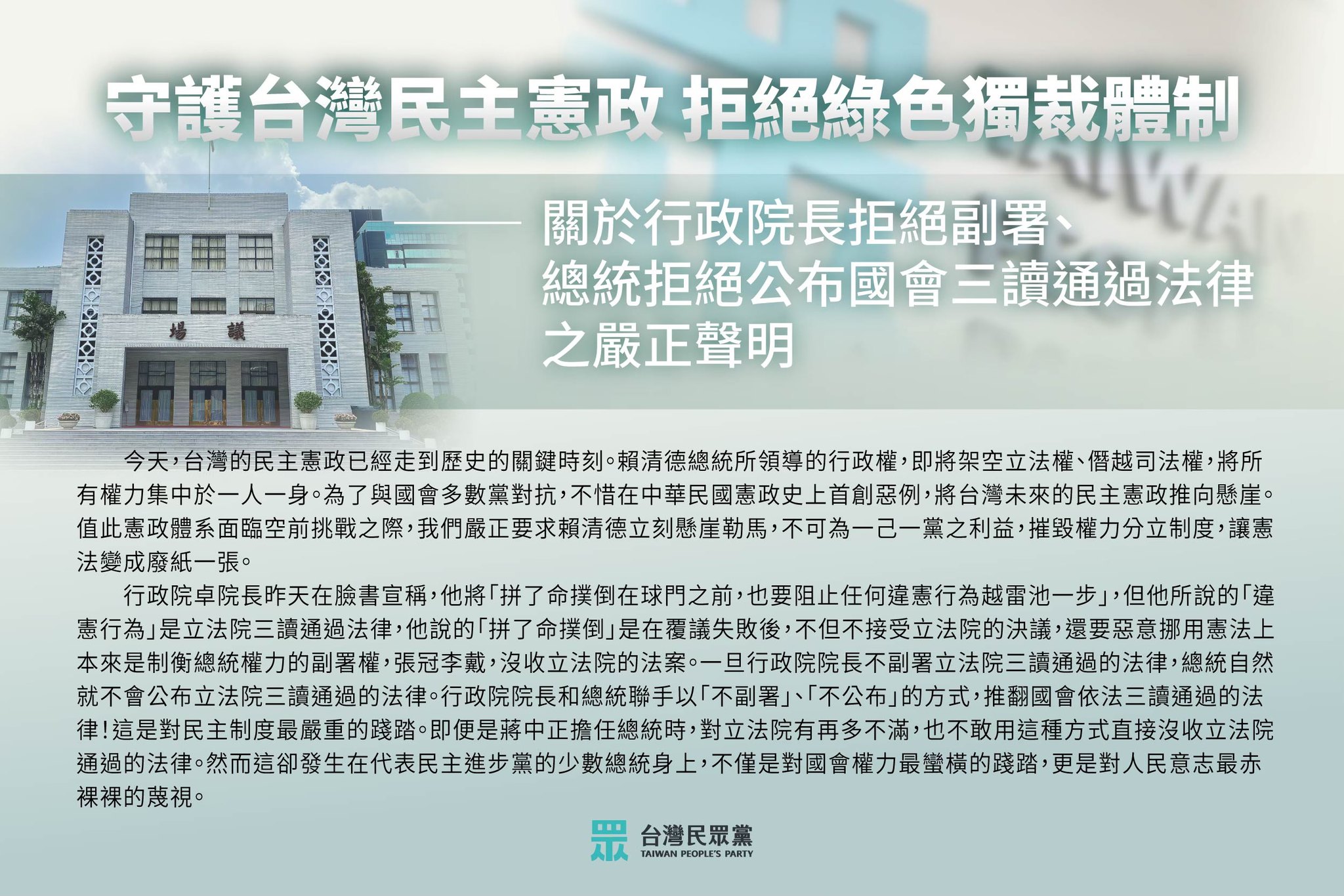
TPP Official Statement
"Safeguarding Taiwan's Constitutional Democracy, Rejecting Green Dictatorship"
— A solemn statement regarding the Premier’s refusal to countersign, and the President’s refusal to promulgate, laws passed by the Legislative Yuan.
Today, Taiwan's constitutional democracy has reached a critical historical juncture. The executive power led by President Lai Ching-te is on the verge of hollowing out the legislative power and usurping the judicial power, concentrating all authority in the hands of a single individual. In order to confront the majority party in the Legislative Yuan, he has not hesitated to set a pernicious precedent in the constitutional history of the Republic of China, pushing the future of Taiwan's constitutional democracy to the brink of a cliff.
At this moment, as our constitutional system faces unprecedented challenges, we solemnly demand that Lai Ching-te pull back from the precipice immediately. He must not destroy the separation of powers for the sake of personal or partisan interests, reducing the Constitution to a mere scrap of paper.
Yesterday, Premier Cho Jung-tai declared on Facebook that he would "risk his life diving in front of the goal post to prevent any unconstitutional act from crossing the line." However, the "unconstitutional act" he refers to is actually the law passed by the Legislative Yuan through its third reading. His so-called "diving defense" implies that, following the failure of the reconsideration motion, he not only refuses to accept the Legislative Yuan's resolution but also maliciously misappropriates the power of countersignature—originally designed to check the President's power—to effectively confiscate the bills passed by the Legislative Yuan, thereby confusing distinct constitutional concepts.
Once the Premier refuses to countersign a law passed by the Legislative Yuan, the President will naturally refrain from promulgating it. By jointly employing "non-countersignature" and "non-promulgation," the Premier and the President are overturning laws duly passed by the Legislative Yuan! This constitutes the gravest trampling of the democratic system.
Even when Chiang Kai-shek served as President, no matter how dissatisfied he was with the Legislative Yuan, he never dared to directly nullify laws passed by the Legislative Yuan in this manner. Yet, this is occurring under a "minority president" representing the Democratic Progressive Party (DPP). This is not only a savage trampling of the Legislative Yuan's power but also a naked contempt for the will of the people.
1. The Constitutional Significance of the countersignature system must not be distorted.
Article 37 of the Constitution stipulates: "The President shall, in accordance with law, promulgate laws and issue mandates with the countersignature of the President of the Executive Yuan or with the countersignatures of both the President of the Executive Yuan and the Ministers or Chairmen of Commissions concerned." Historical interpretations by the Grand Justices, such as Interpretation Nos. 419 and 627, consistently hold that the Premier's countersignature serves as a check and balance on the President's power.
In his concurring opinion for J.Y. Interpretation No. 735, Grand Justice Huang Mao-zong explicitly stated: "According to the aforementioned provisions, the President's powers are subject to the restraint of the Premier's countersignature, and the Executive Yuan shall be responsible to the Legislative Yuan." The countersignature system must absolutely not serve as a basis for the Executive Yuan to veto laws passed by the Legislative Yuan; doing so is an abuse of power that distorts constitutional norms.
2. Upon the Failure of Reconsideration, the Executive Yuan must immediately accept the Legislative Yuan's resolution.
According to Article 3 of the Additional Articles of the Constitution, if the Premier deems a law passed by the Legislative Yuan difficult to execute, they may request the Legislative Yuan to reconsider it. If the reconsideration fails, "the President of the Executive Yuan shall immediately accept the said resolution."
With such a simple and clear provision, how has it evolved into a situation where the Premier can overturn the result and renege on the outcome by refusing to countersign? If the Premier can simply "refuse to countersign" a law that has passed the third reading and survived a motion for reconsideration, what meaning remains of the constitutional "reconsideration" system? Should the Premier simply appoint himself as the legislator?
3. The Great Recall, The Great Failure, and The Great Flip.
Last year, the DPP government brazenly refused to accept the Law Governing the Exercise of Powers of the Legislative Yuan passed by the Legislative Yuan, unwilling to fulfill its political promise to accept oversight by the LY. This year, they initiated recall campaigns against KMT legislators, only to face total defeat.
After this "Great Recall" resulted in a "Great Failure," they have simply chosen to ignore the latest public will, refusing to admit defeat or honor the outcome. Instead, they are abusing the countersignature system to directly confiscate laws passed by the Legislative Yuan.
They flip the table repeatedly, to the point of overturning the very constitutional democratic system upon which the Taiwanese people rely for survival.
It is evident that this is a "Great Flip" by a DPP government that refuses to concede after repeated failures, treating the Taiwanese people with utter disregard.
4. Unconstitutionality is not for the President or the Premier to Unilaterally Determine.
The Premier’s justification for refusing to countersign is his belief that the laws passed by the majority in the Legislative Yuan "destroy the national constitutional system" .But is it up to the Executive Yuan to unilaterally determine whether these laws are unconstitutional?
This has completely thrown the system of separation of powers into chaos, allowing the Executive Yuan and the President to act as Grand Justices themselves by refusing to countersign and promulgate laws.
Separation of powers and checks and balances emphasize the "anti-aggrandizement principle." If a state organ expands its own power at the expense of weakening another constitutional organ, it violates the principle of separation of powers. They are unhesitatingly embarking on the path of a dictator.
5. The President is responsible for the Constitutional Court Stalling.
The President is leading the violation of the Constitution while preventing the Constitutional Court from functioning (do not forget, the DPP caucus in the LY, with the President serving as Party Chairman, even used party discipline to vote down the President's own nominees that the party had agreed upon). President Lai Ching-te must bear ultimate responsibility for the idling of the constitutional system.
6. A System More Dictatorial Than Dictators.
Lai Ching-te has a habitual tendency to confront the Legislative Yuan; as a local government head, he refused to enter the council chamber to answer interpellations. Now, as President, he simply treats the Legislative Yuan as if it were air. He uses a "player and referee" approach to block laws that have been discussed in detail from committees to the floor of the Legislative Yuan.
Even during the martial law era, despite President Chiang Kai-shek's dissatisfaction with the Legislative Yuan, procedurally, he never refused to promulgate laws, nor did he demand the Premier veto laws passed by the Legislative Yuan through refusal of countersignature. This is a power that even dictators dared not exercise.
7. The People Are the Masters of Taiwan's Democracy, Not Lai Ching-te.
The historical infamy of "confiscating laws passed by the Legislative Yuan" will be affixed to the DPP and can never be removed. With local elections approaching, the people will use their votes to tell the ruling authorities: Taiwan does not need a dictator! Taiwan needs a government that respects the Constitution, respects the Legislative Yuan, and respects the people!
Our Stance and Demands:
1. The Premier must countersign the laws passed by the Legislative Yuan in accordance with the Constitution!
2. The President must promulgate the laws passed by the Legislative Yuan in accordance with the law!
3. The Executive branch must execute the laws passed by the Legislative Yuan in accordance with the law!
4. The President and the Premier must immediately stop destroying the system of separation of powers and respect the Legislative Yuan's legislative power, budget review power, and power of consent for personnel appointments.
5. Acts that destroy constitutional democracy, trample on the rule of law, and implement autocratic dictatorship will ultimately face punishment by public opinion and the judgment of history.
Taiwan's democracy was hard-won! We will absolutely not tolerate any person or political party destroying the constitutional system or trampling on democracy under any pretext. This is a crisis in Taiwan's democratic history that cannot be ignored. We call on all people to join together to Resist the DPP's Unconstitutional Conduct.