



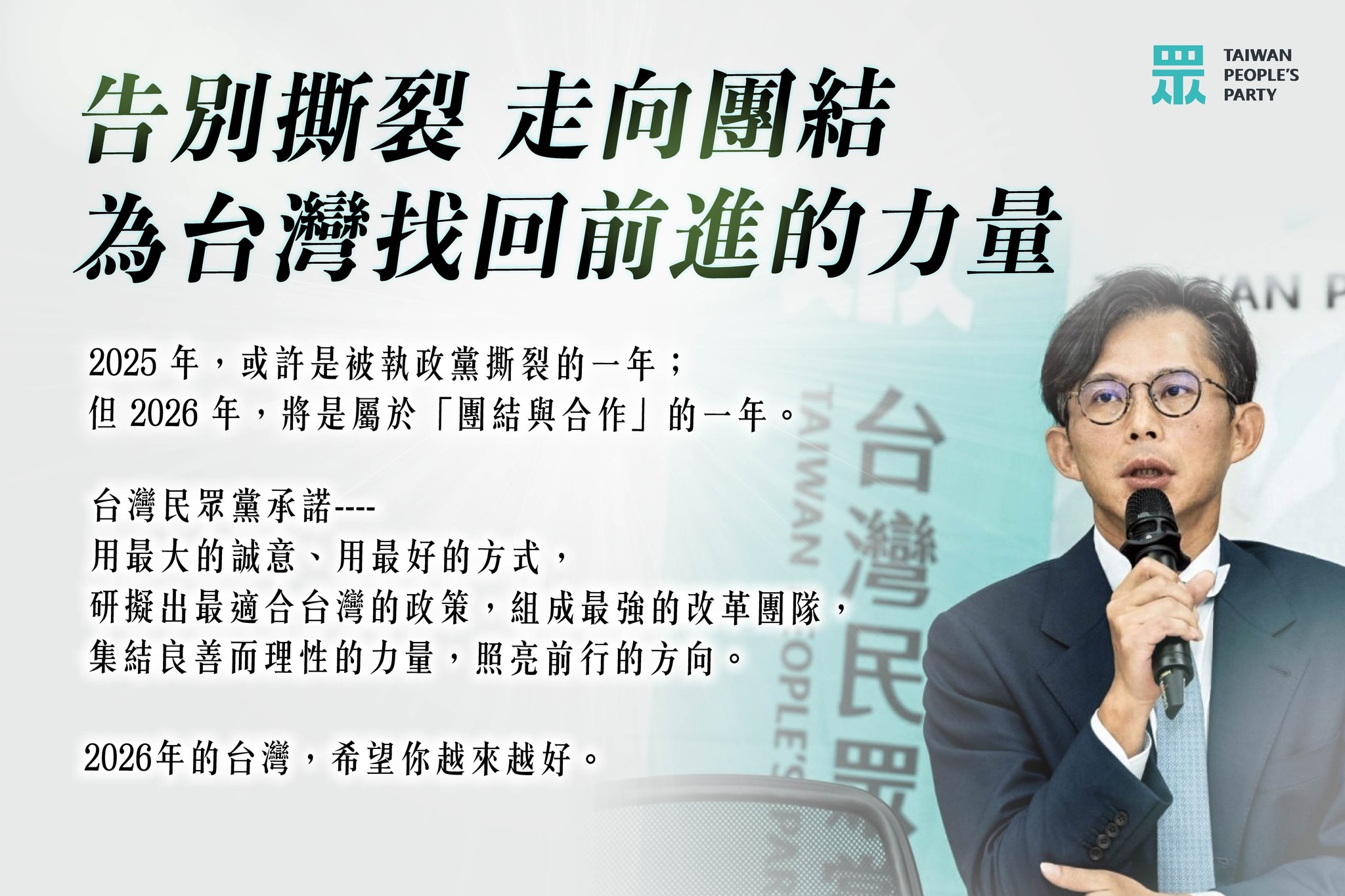
Bid Farewell to Division, Move Towards Unity: Reclaiming the Momentum for Taiwan's Progress
Bid Farewell to Division, Move Towards Unity: Reclaiming the Momentum for Taiwan's Progress
Taiwan in 2026: We hope you continue to grow better and stronger.
Looking back at 2025, whether on the international stage or the domestic front, we found ourselves amidst intense instability and unease.
Internationally, the ripples caused by tariff wars need no introduction. The ceasefires in Russia-Ukraine and Israel-Hamas, which the world had eagerly awaited and discussed for over half a year, have yet to reach a conclusion. The United States’ declaration of a drug war against Venezuela has added new flames of conflict. Meanwhile, the military standoff between Thailand and Cambodia has, fortunately, not escalated into a more serious conflict.
Domestically, Taiwan has been equally tumultuous. On New Year's Day last year, President Lai Ching-te declared in his New Year's address that he would "bolster national strength through democracy and welcome a new global landscape." However, a year has passed, and society will form its own fair judgment on whether national strength has actually been bolstered. What is certain is that as the international situation becomes increasingly volatile, the internal and external pressures Taiwan bears have increased rather than decreased, and internal confrontations have shown no sign of easing. Various livelihood and economic data clearly indicate that Taiwan is facing numerous long-accumulating structural crises that were never squarely addressed—all of which erupted in 2025:
1. Birth Numbers Hit New Low: The Decline is Out of Control
2025 threatens to become the year with the lowest birth population in Taiwan's history. As of the end of November, there were only 98,785 newborns, and the annual total will likely fall short of 110,000. Under ten consecutive years of Democratic Progressive Party (DPP) governance, the birth population has decreased by a cumulative total of approximately 100,000. Birth numbers have seen negative growth for nine consecutive years, and the fertility rate has plummeted to the lowest in the world. This is not an accidental phenomenon, but the result of long-term policy failure.
2. Widening Wealth Gap: A Serious Regression in Distributive Justice
According to the latest World Inequality Report, inequality in Taiwan is on the high side. The wealthiest 10% of the population controls 61% of the nation's wealth, while the bottom 50% owns only 12%. The income gap between the richest 5% and the poorest 5% has reached a staggering 150-fold difference—nearly doubling compared to 2011. The DPP repeatedly boasts of economic growth, yet allows the benefits to remain highly concentrated, leaving the majority of people unable to share in the fruits of development.
3. Hardest Time for Youth to Start Families: Generational Pressure Intensifies
Long-term wage growth fails to keep up with high inflation and high housing prices; for the younger generation, "starting a family and career" has become a luxury. Since 2016, housing prices across Taiwan have risen by over 220%, while average total wages have grown by only 22%. With rent indices climbing year after year, young people are forced to choose between "not eating or drinking for ten years to save" or "becoming mortgage slaves," trapped in a dilemma where they "cannot afford to buy and find renting too expensive."
4. Energy Policy Errors: Economic Risks Continue to Amplify
The DPP's erroneous green energy policy, combined with the shutdown of Taiwan's last nuclear power plant, has driven the proportion of low-carbon energy generation to a record low. In 2024, low-carbon energy accounted for only 15.7% of total generation, and by September of this year, it dipped even further to 8.9%. Compared to Japan (35.3%), South Korea (42.7%), and Vietnam (46.5%), Taiwan has already lost at the starting line regarding traditional industries. Furthermore, the "temporary" reciprocal tariffs imposed by the US remain as high as "20% + N" or more; with agreements still not finalized, we do not know how long "temporary" will last. Compared to countries like Japan, Korea, and Vietnam that have settled their negotiations, Taiwan's economic future is fraught with high uncertainty.
5. Constitution Treated as a Plaything: Grand Justices Reduced to Tools
Facing a Legislative structure where no single party holds a majority, President Lai has consistently refused to accept reality, acting willfully and alone. Even after the total defeat of the "Great Recall" campaign, he remains obstinate: from arbitrarily distorting constitutional articles and the Premier illegally overstepping authority to using "unconstitutionality" as an excuse to refuse countersigning laws passed by the legislature. From paralyzing Legislative operations to manipulating independent agencies, the Constitutional Court and the judicial system have been reduced to political enforcers for the party. The current ruling party is systematically dismantling the firewall of the separation of powers, turning the oversight mechanisms designed by the Constitution into ruins trampled upon at will by those in power.
As a responsible third-largest party, the Taiwan People's Party has spent the past year not only protesting judicial injustice to fight for the innocence of former Chairman Ko Wen-je but also proposing various reform efforts for the long-term stability and peace of our nation and society:
#To slow the declining birthrate: We joined hands with the Kuomintang (KMT) to push for the "Taiwan Future Account," encouraging labor, management, and government to jointly support quality child-rearing policies.
#To reduce the physical and mental burden on citizens: We proposed restoring four national holidays and amending laws to allow long-term care expenses to be deductible from income tax.
#To assist the development of today's youth: To lower economic burdens, we actively pushed for the "Basic Youth Law" and promoted further amendments to the "Housing Act."
#To fight for reasonable space in Taiwan's energy mix: We promoted the referendum on the "Extension of Nuclear Plant No. 3," obtaining the support and consent of over four million citizens.
#To maintain the dignity of the Constitution: We filed an impeachment motion against the President in the legislature, demanding that the President not forget the solemn oath he made to the people upon taking office.
Furthermore, for the rationality and stability of Taiwan's political and social development, the Taiwan People's Party has continuously advocated the concept of a "Coalition Government" over the past few months, seeking a solution for Taiwan's path forward.
Regrettably, despite the many internal and external problems Taiwan faces, our President Lai Ching-te has largely turned a deaf ear. Instead, he is keen on creating enemies within the nation, labeling dissidents, dividing society, and simplifying "Love Taiwan" into a tool for political struggle. Particularly when the ruling party repeatedly replaces governance with confrontation and masks incompetence with division, opposition parties have a responsibility to hold this country up and safeguard its democracy and future.
2025 may have been a year torn apart by the ruling party; but 2026 will be a year belonging to "Unity and Cooperation."
The Taiwan People's Party will uphold the promise of the "Four Mosts"—using the most sincerity and the best methods to draft policies most suitable for Taiwan, forming the strongest reform team. In this moment when the prospects for democracy and the people's livelihood are dim and unclear, we choose to rally all kind and rational forces to light a lamp for Taiwan, illuminating the way forward.