


Taiwan People's Party Press Release 2026.3.26
Taiwan People’s Party Press Release
Ko Wen-je Condemns Court for Losing Fairness and Independence, Says Judiciary Has Become a Political Tool
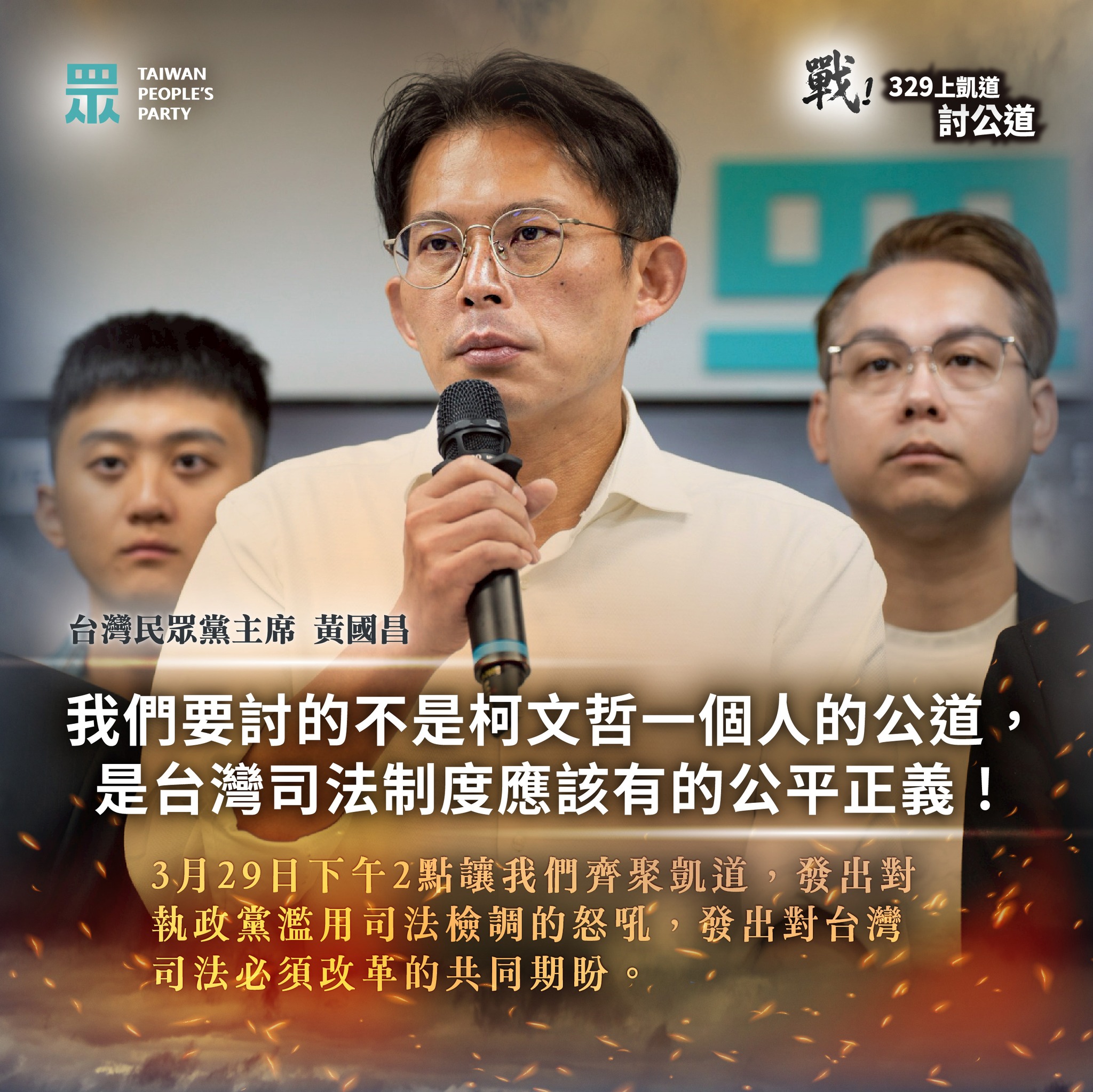
KC Huang Issues Nationwide Mobilization Order: Fight Back! Gather on Ketagalan Boulevard on March 29 to Demand Justice
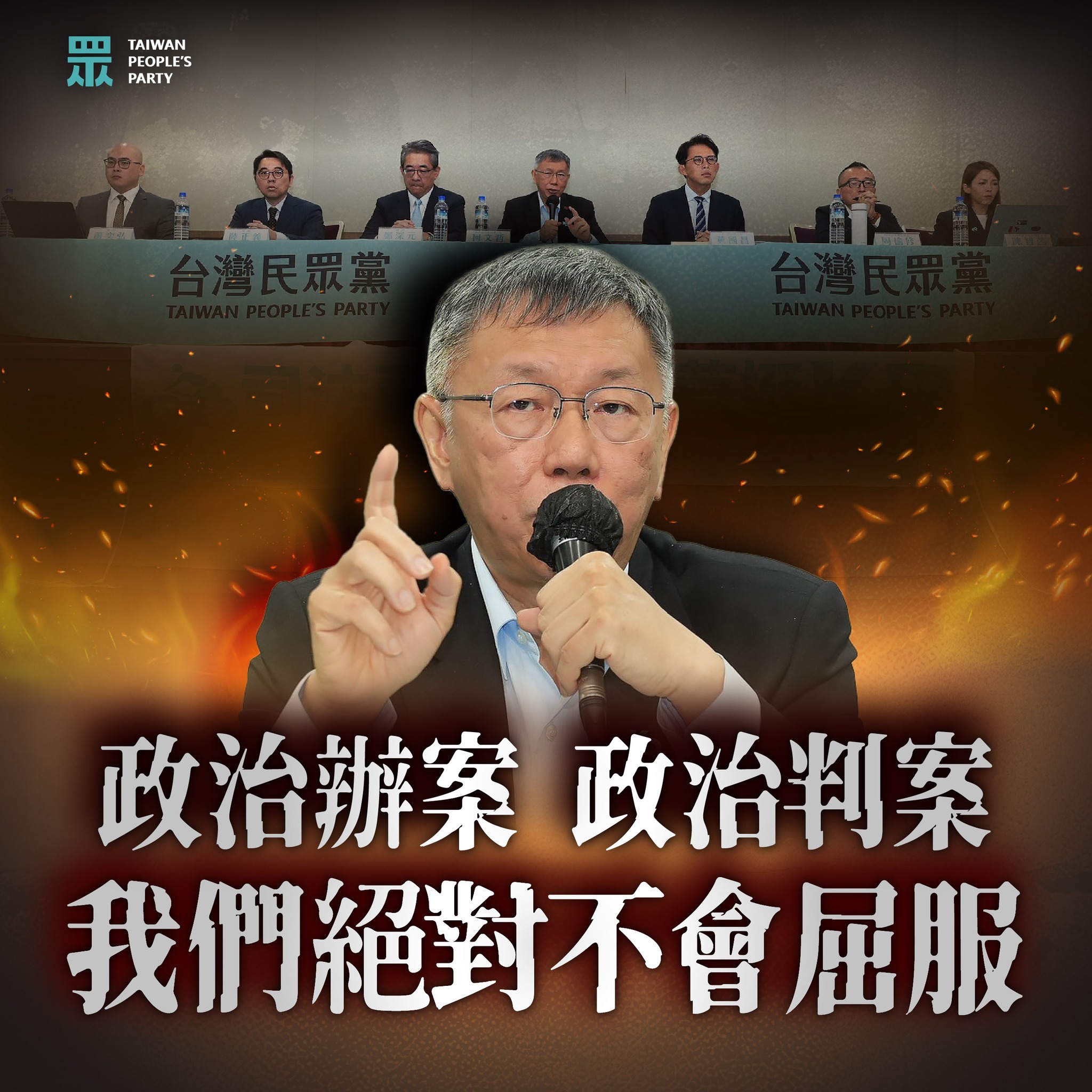
Ko Wen-je, the founding chairman of the Taiwan People’s Party (TPP), received a first-instance verdict today. In the “Core Pacific City case” and the “political donations case,” the Taipei District Court sentenced him to a combined prison term of 17 years and deprivation of civil rights for six years. Ko, together with his legal team, TPP Chairman KC Huang, Secretary-General Chou Yu-hsiu, and caucus director Chen Chih-han, held a press conference to point out the absurdities of the ruling from a legal standpoint. They stated that the verdict fundamentally violates the principles of fairness, justice, and openness expected of a court, and shows a complete lack of judicial independence. Chairman Huang stated that the party will never back down. “We will become even more united and take action.” He called on supporters nationwide to gather on Ketagalan Boulevard this Sunday (March 29) to demand justice for founding chairman Ko and for Taiwan’s judiciary, which he said has been trampled upon. He also called on President Lai Ching-te and the Democratic Progressive Party (DPP) not to evade responsibility, but to come forward and face the public. He said the TPP will stand firmly on the front lines and fight against the “green authoritarianism” to the very end. Founding chairman Ko also stated emphatically that throughout the investigation and trial process, there have been numerous irregularities, with no fairness or independence. “We must stop the continued deterioration and corruption of the judiciary, and prevent it from becoming a political tool. This trial is not over.” He added, “Lai Ching-te! We will never compromise, and we will never surrender!”
Caucus Director Chen stated that this case will undoubtedly be recorded in Taiwan’s history. The absurdities of today’s verdict are far beyond the vague “time and place,” “Excel pay,” and the groundless accusations — there are now even more such examples. The Taipei District Court ruled that a NT$2.1 million political donation made to the TPP constituted bribery in violation of official duties and involved a quid pro quo relationship. Even though the judge acknowledged that the amount was disproportionate, and even though Ko had no knowledge of it, the court still ruled that the NT$2.1 million constituted an upfront payment, implying that there must have been a later payoff. Despite the lack of any evidence of such a payoff, Ko still convicted of serious corruption charges—amounting, Chen said, to a “political death sentence” for both Ko and the party.
Ko Wen-je’s attorney, Cheng Shen-yuan, stated that after reviewing the reasoning behind the verdict, many people found it surprising, and that when examining the trial process step by step, it clearly violated the principles of fairness, justice, and openness. He outlined four principles of a fair trial: equality of arms between prosecution and defense, protection of the right to defense, presumption of innocence, and judicial independence. “None of these principles were present in this case,” he said. “What we saw was a court without procedural safeguards and without protection of litigants’ rights.”
Cheng pointed out that the principle of equality between prosecution and defense was absent. The prosecution continuously submitted supplementary arguments—on top of more than 170 original case volumes, it added up to 30 supplementary filings totaling over 3,000 pages of evidence. These were submitted without restriction, sometimes just days before witness cross-examinations, and coordinated with specific media coverage, leaving the defense overwhelmed. In Supplementary Filing No. 18, the prosecution even expressed dissatisfaction with the testimony of Shao Hsiu-pei and threatened to change sentencing recommendations, attempting to pressure Peng Chen-sheng, a witness who had yet to testify. This pressure ultimately contributed to Peng’s wife jumping from a building and taking her own life. This demonstrates that the prosecution sought to influence the fairness of the trial, yet the Taipei District Court took no action.
Cheng emphasized that judges must remain impartial—they are neither enforcers for the prosecution nor shields for the defendant, but neutral arbiters. However, witness Huang Ching-mao consistently denied any wrongdoing, yet Prosecutor Lin Chun-yen forcibly falsified the interrogation record, potentially constituting the crime of document forgery by a public official. After defense counsel formally filed a complaint in court against Prosecutor Lin, the court made no mention whatsoever of the falsification of Huang’s interrogation record, nor did it report the matter as required by law. By turning a blind eye to fabricated evidence, the court has not only demonstrated a lack of moral courage, but has also violated Article 241, Paragraph 1 of the Code of Criminal Procedure, which stipulates that “a public official who, in the execution of his duties, becomes aware of a suspected offense shall report it,” thereby constituting dereliction of duty.” He further noted that due to the vast amount of case materials, the defense could not verify whether interrogation recordings matched written records. Does this mean the court is tacitly allowing prosecutors to insert statements that were never made? Does the court itself risk dereliction of duty? Furthermore, the court failed to lawfully and independently assess the testimonies of Peng Chen-sheng, Shao Hsiu-pei, Chu Ya-hu, Lin Chin-jung, and others. It also failed to report Lin Chin-jung’s alleged perjury as required by law, thereby compromising its impartiality.
Cheng emphasized that there were serious issues with the testimonies of witnesses including Peng Chen-sheng, Yang Chih-sheng, Shao Hsiu-pei, Chu Ya-hu, and Chen Chun-yuan, yet the panel of judges took no action whatsoever. The court appeared to accept the Taipei District Prosecutors Office’s claims wholesale. If the defense failed to identify an issue, does that mean the prosecution can pretend not to know? And the court can also pretend not to know? Furthermore, regarding the prosecution’s failure to submit the full case files, raising concerns that evidence favorable to the defendant may have been withheld, the court also turned a blind eye. At the beginning of the preparatory proceedings, in order to prevent the prosecution from concealing evidence favorable to the defense, the defense requested that the court order the prosecution to submit all case files and ensure that no seized evidence would be withheld. “Did the court make such a request? No.” At the time, the prosecution argued that Ko should be detained on the grounds that he might collude with Chen Pei-chi, and promised to immediately provide Chen’s interrogation records to the defense. The court accepted this claim and ordered detention. “But were the records ever provided? No.” Clearly, the court imposed no requirements or constraints on the prosecution, failed to respond to the defendant’s requests, and allowed the prosecution to withhold evidence. “Where is the fairness of a fair court?”
Cheng further stated that whether the Taipei District Court violated the principles of fairness, openness, and judicial independence in handling this case is something the public can judge for themselves. However, what is most shocking is that the court determined that the NT$2.1 million political donation from Core Pacific Group to the TPP constituted a bribe received by Ko Wen-je, and found him guilty of bribery in violation of official duties. The presiding judge even stated in court that “the NT$2.1 million was an upfront payment; although small, there may have been a later payoff.” Cheng questioned: since the NT$15 million alleged by the prosecution was deemed by the court to lack sufficient evidence and not constitute a later payoff, then where exactly is this so-called “later payoff”? With no substantive evidence, to conclude that NT$2.1 million alone constitutes bribery in this case is incomprehensible and utterly absurd.
Cheng also pointed out that the court determined that after Shen Ching-ching entered the mayor’s office, Chu Ya-hu, who was waiting outside, saw Shen exit “with a smile,” and on this basis concluded that the two parties had reached a “tacit agreement” and formed the basis for bribery. However, the court does not know what was discussed or why he smiled—how can this be used to determine bribery? Is this not absurd? The NT$2.1 million political donation was directly deposited into the TPP’s political donations account and was subsequently used for legitimate party operations. Ko Wen-je never withdrew a single dollar from this account for personal use. Furthermore, who would offer a bribe through a political donations account that is publicly searchable through the Control Yuan system? The court’s ruling defies common sense and logic. To link a NT$2.1 million donation to as much as NT$120 billion in floor area ratio benefits is completely disproportionate and unreasonable.
Regarding the procedural flaws and improper reasoning in the first-instance trial, the defense expressed deep regret that the principles of fairness and openness were not upheld, resulting in this judgment. Ko Wen-je’s legal team will study the written judgment upon receipt and consider filing an appeal. In the second instance, they will seek to uncover the full truth of the case, rather than the narrative presented by the prosecution, and will request that the High Court livestream the proceedings for public scrutiny to safeguard judicial justice and procedural fairness.
Attorney Lu Cheng-yi stated that the court accepted the prosecution’s indictment wholesale, despite the fact that “not a single dollar of political donations was used for Ko’s personal benefit,” and “not a single cent of the TPP’s funds entered Ko’s personal pocket.” The prosecution charged Ko with misappropriation on the grounds that he used surplus political donations to pay campaign staff salaries. However, the Ministry of the Interior has issued official interpretations stating that such use is permissible, and reports from the Investigation Bureau also indicate that using political donations in this way is not illegal. The Supreme Administrative Court and the Control Yuan have likewise held that once political donations are made to a political party or candidate, the funds belong to that party or candidate, subject only to restrictions on usage. Therefore, political donations do not constitute “property of another” under the Criminal Code’s offense of misappropriation. Yet the prosecution insisted on filing charges, and the court accepted them without question.
Lu further emphasized that the prosecution charged Ko with misappropriation for paying NT$1 million in surplus political donations to Chiu Fu-sheng as an “investment.” However, Chiu himself testified that Ko engaged him to help enhance the party’s online presence and develop it into a digital political party. The two parties even signed a service contract and project proposal. The funds were therefore entirely used for party purposes and were fully lawful. Nevertheless, the prosecution still characterized this as a personal investment. Even ticket revenues from the “KP Show,” totaling over NT$770,000, were deemed misappropriation. Lu cited former President Tsai Ing-wen as an example, noting that fundraising banquet tickets sold for NT$50,000 each despite costs of only NT$1,000 to NT$2,000, representing a markup of dozens of times—yet these are considered political donations. Similarly, during President Lai Ching-te’s campaign, fundraising meal boxes were sold for NT$10,000 each, also representing a large markup, and were likewise considered political donations. Yet when Ko held the “KP Show” concert, ticket prices were NT$8,800, with costs as high as NT$7,524—less than a twofold markup—so how can this be considered political donations? Moreover, the tickets were sold by MuKe Company, and the funds belonged to that company; Ko never received any of the money. Yet the Taipei District Court still convicted him of misappropriation. This, Lu stated, is a clear case of fabricated charges.
Lu Cheng-yi raised a series of pointed questions to the prosecution:
Why is using surplus political donations to pay campaign staff salaries considered misappropriation by Ko Wen-je?
Why is paying NT$1 million to Chiu Fu-sheng for digital development planning considered misappropriation?
Why is Ko Wen-je deemed to have misappropriated funds from the KP Show when he did not receive a single dollar?
Why does MuKe Company selling tickets amount to misappropriation by Ko Wen-je?
Lu stated that the ruling is filled with prosecutorial bias. From the outset, the prosecution operated under a presumption of guilt, deliberately distorting the nature of political donations. This is a case of “poisonous fruit from a poisonous tree,” and what is groundless remains groundless.
Attorney Hsiao Yi-hung stated that the case “cannot be separated from politics.” The Taipei District Court’s press release claimed that the floor area ratio incentives lacked legal basis, yet a Ministry of the Interior interpretation dated July 28, 2023 recognized them as compliant with regulations. After the Control Yuan became involved, the case took a complete reversal. Civil servants in the Department of Urban Development even stated that “the Control Yuan viewed the matter through a biased lens, and the Ministry of the Interior simply played along—it was all political maneuvering.” Hsiao emphasized that every civil servant involved acted in accordance with the law. This is a case in which administrative discretion has been distorted by politics, supervisory power, and investigative authority. At the time of the events, Ko Wen-je was fully engaged in responding to the pandemic, and his only approach to professional matters was “openness, transparency, and respect for expertise.” All meetings were livestreamed and remain available on YouTube.
Hsiao further stated that if prosecutors and judges, under political pressure, transform administrative discretion into criminal liability, the harm will extend beyond Ko to the entire civil service system. This ruling sends a message to all civil servants: “Even when you are confident that you are acting lawfully, you may later be deemed guilty, because the state may abandon you and the government may abandon you. When you are willing to take responsibility, you may end up in prison.” He added that, apart from Lin Chin-jung, no civil servant was found to have acted unlawfully or been instructed to commit a crime. On the contrary, civil servants testified in court that “the procedures in this case were entirely lawful.”
TPP founding chairman Ko Wen-je reiterated: “I did not engage in illicit enrichment. I did not commit corruption. I am completely upright.” He stated that treating a NT$2.1 million political donation—of which he had no knowledge—as bribery is pure defamation. “You think that by destroying Ko Wen-je, you can remove an obstacle for the ruling party in future elections. But even if you destroy one Ko Wen-je, there will be countless ‘little grass,’” he said. He added that when the fabricated NT$15 million could not be used to convict him, the court instead used the NT$2.1 million donation to the party to convict him of corruption. They relied on an inexplicable confession by Chu Ya-hu to establish guilt. Li Wen-tsung, once labeled as a “front man” for bribery, was ultimately found not guilty, yet was still detained for 11 months. “For what purpose?” Ko asked. “This is clearly a politically driven prosecution.”
Ko stated that the entire Core Pacific City case was marked by “lack of due process, improper disclosure of investigations, and presumption of guilt.” During the proceedings, judges rarely questioned the case and instead followed the prosecution’s constructed narrative. He added that when the fabricated NT$15 million could not be used to convict him, the court instead used the NT$2.1 million donation to the party to convict him of corruption. They relied on an inexplicable confession by Chu Ya-hu to establish guilt. Li Wen-tsung, once labeled as a “front man” for bribery, was ultimately found not guilty, yet was still detained for 11 months. “For what purpose?” Ko asked. “This is clearly a politically driven prosecution.”
He emphasized that “the judiciary must not be a political tool, and must not be used by those in power to suppress opposition parties.” Procedural justice is the cornerstone of the rule of law. Without procedural justice, there is no substantive justice. Yet today we see presumption of guilt replacing presumption of innocence, detention and coercion replacing substantive evidence, political positions overriding due process, and prosecutors acting without constraint. When judges no longer uphold independent adjudication, what collapses is not just a single case, but the public’s trust in the entire judicial system. If prosecutorial misconduct is not isolated but collectively tolerated, then those most harmed will be the most vulnerable people.
Ko stated that the fundamental principles of a rule-of-law state in Taiwan have been eroded. “In this trial, the rules of evidence were abandoned, testimonies were selectively accepted, and procedural justice completely disappeared.” He stressed that this trial will be recorded in Taiwan’s history. If judicial reform has a starting point, it must be here and now—not some vague “time and place.” The TPP will fight to the end to defend Taiwan’s last democratic line of defense.
Chairman KC Huang strongly condemned the ruling as “a completely fabricated political judgment.” He pointed out that the prosecution’s earlier claim of the so-called “Excel 1500” had already become a public joke, yet the court, after failing to sustain that argument, turned instead to the NT$2.1 million political donation—of which Ko Wen-je had no knowledge—as evidence of bribery. Huang criticized the court for using Shen Ching-ching’s “smile upon exiting the meeting room” as evidence of a tacit agreement, completely disregarding strict evidentiary standards. He argued that the court had only one goal: to satisfy the DPP’s political objective of securing a prison sentence of more than ten years for Ko. Even without evidence of a later payoff, the court arbitrarily treated the payment as an “upfront payment.” He described the ruling as a disgrace to Taiwan’s judiciary.
Huang further stated that this was a case of “shooting the arrow first and then drawing the target.” He accused the court of shielding prosecutors who fabricated records and used intimidation in their investigation, while turning a blind eye to clearly false documentation. “What kind of judiciary is this? What kind of rule of law is this?” he asked. If the DPP government can use such methods against Ko, then anyone could become the next victim.
Huang formally announced that the party will convene an expanded joint meeting and issue a nationwide mobilization order, calling on supporters to gather on Ketagalan Boulevard this Sunday (March 29) afternoon to demand justice. He urged President Lai Ching-te to face the anger of the people, and stated that the TPP will stand on the front lines and resist the “green authoritarianism” to the very end.